
Clearing the home of a deceased relative in Quebec City: step-by-step guide
An honest, practical guide for estate executors: administrative deadlines, sorting method, inheritance rights, specialized services. Without minimizing the grief.
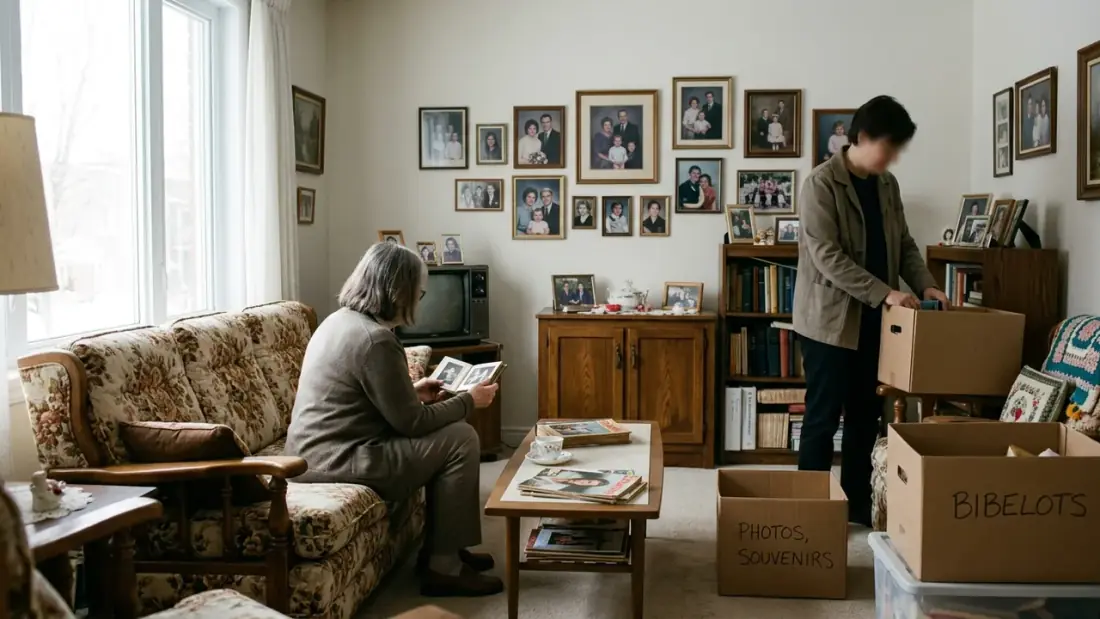
If you’re reading this, you’re probably dealing with a difficult situation: a parent, spouse, brother, or sister just passed away — and you must now empty their home. This guide is written for the estate executor (the “liquidateur” in Quebec) or the family in charge. It’s detailed because the job is, too. And it’s honest because you don’t need false reassurance.
Before anything: you’re not alone
Every year in Quebec City, around 6,500-7,000 people die. Each family finds itself, sooner or later, with the same task. The fact that it feels overwhelming is normal. The fact that it brings up emotions, unspoken words, conflicts — normal. The fact that it takes much longer than expected — normal.
This guide gives you the practical framework. For the emotional side, don’t hesitate to reach out for support: Centre de crise de Québec (418-688-4240), your doctor, a psychologist. This article doesn’t replace them.
The context: what the executor must do (briefly)
In Quebec, once a person dies:
- A liquidateur (estate executor) is named in the will, or designated by the heirs
- This person has the legal mission of liquidating the estate: pay debts, sell assets, distribute what’s left
- The liquidateur has 10 months to render accounts (extendable)
Clearing the home is part of this liquidation — but it can be one of the last steps on the timeline. Take the time to do it right.
Timeline: when to empty the home
❌ NOT the first week
The first week is for: formalities (death certificate, funeral), notifying loved ones, grieving. Don’t touch the home.
❌ NOT the first month
The first month is for: reading the will, meeting the notary, consolidating heirs. Not yet.
✅ From the 2nd or 3rd month
Once you have:
- The official inventory of assets
- Agreement between heirs on WHAT is distributed
- A clear timeline (will the house be sold? rented? kept?)
Only then is it time to empty.
Exceptional urgency scenarios (physical cleanout required sooner)
- The deceased rented an apartment: lease continues, landlord wants it back — plan the cleanout within 30 days of notifying the landlord
- Weather/insurance issue: water damage, rodents — intervene immediately, document everything by photo
- Mortgage in default: the bank may force proceedings — consult a notary urgently
Step 1: The inventory
Before throwing anything, make the inventory. It protects you legally (against other heirs, tax authorities) and emotionally (so you don’t regret later).
What to inventory:
- Jewellery, pieces of value (antiques, art, coins)
- Electronics (TV, computer, phones, tablets)
- Vehicles and their documents
- Identity documents (cards, passports, credit cards to cancel)
- Bank statements and tax documents (past 6 years minimum)
- Personal papers: letters, photos, journals, wills
- Digital assets: accounts Facebook, email, cloud storage
Practical method:
- Go room by room with a notebook
- Photograph each piece that might have value
- Save papers in one spot (donate to notary if unsure)
- NEVER throw anything during this stage
Sensitive items — what to do
- Firearms: the liquidateur must notify the Sûreté du Québec. If legally registered, an heir can take ownership. Otherwise: SQ takes it.
- Prescribed medications: return to pharmacy (they destroy legally)
- Syringes: yellow sharps container, pharmacy
- Animals: immediately rehomed with family or local SPA
- Keys (bank safe, safety deposit boxes, property titles): keep separately
Step 2: The tri (sorting) — by category
After the inventory, decide for each class of objects what happens.
Class A — Distributed to heirs
Items specifically mentioned in the will go to their designated heir. Write and date the delivery (signed receipts).
Class B — Sold / auctioned
Items of real value (antiques, art, quality furniture, collections). Two options:
- Estate auction (EncansRichelieu, Jones Auction, specialists in Quebec City) — they pick up, auction, take 15-30% commission
- Individual sale: Marketplace, Kijiji, antique dealers
Class C — Donated
Items in good condition but without specific inheritance or buyer value: Renaissance, Saint-Vincent-de-Paul, Salvation Army. Tax receipts possible for the estate. See our donation centres guide.
Class D — Discarded
Worn clothing, broken dishes, outdated documents, bathroom products, everything unusable. This is where our service intervenes.
Class E — Kept for the archives
Family photos, letters, historical documents, unique pieces.
Step 3: The cleanout (our service in context)
Once classes A-E are decided, our service takes care of class D (discarded) and can handle class C (donations) with drop-offs on route.
What we typically do in an estate cleanout in Quebec City:
Preparation call (30 min):
- You describe the home + access + our contact on site (often a sister, an adult child)
- We estimate volume (usually 1-2 full trucks for a typical Quebec City house)
- We book a 4-6 hour window, often over 1-2 days
On site:
- You (or your representative) are present
- We validate each room with you (“OK, everything in this room goes except the oak dresser that goes to Emma”)
- We sort into: donation (loaded separately), class B if forgotten (we leave to side), class D (our truck)
- We clean up after (sweep, vacuum basic)
Disposal:
- Donations dropped at charities (we give you proof)
- Recyclable/reusable materials sent to appropriate streams
- Rest to Quebec City’s ecocentres
Pricing for estate cleanouts
For a typical Quebec City house:
- Small apartment (2½-3½): $500-800 (1/2 truck)
- Medium house (2-3 bedrooms): $900-1,500 (1 full truck)
- Large house (4+ rooms, full basement, 30+ years of accumulation): $1,800-3,500 (2 trucks, split over 2 days)
Get an exact quote on our pricing page or by phone. For estate cases, we always do a free on-site visit before confirming.
The fiscal aspect
Estate cleanout costs are administrative expenses of the estate — therefore deductible from the inheritance tax calculation. Save all invoices.
Taxation of inherited personal property:
- No tax on succession itself in Canada (no Quebec or federal inheritance tax)
- BUT sale of goods generates capital gains that go to the estate’s tax declaration
- Objects kept personally by heirs = no tax, as long as they’re used, not resold within 1 year (otherwise capital gain rule applies)
For details, see our estate cleanout and taxes in Quebec article.
5 errors to avoid
1. Rushing
“I want to be done in a weekend” is unrealistic for most situations. Allow 2-4 weeks of part-time work for a 2-bedroom house.
2. Deciding alone
If you have siblings, every discovery involves them. Keep photos, text them, don’t throw anything away unilaterally.
3. Forgetting digital assets
Online accounts (bank, Bell, Hydro, government), social networks, cloud storage. All have succession procedures. Don’t ignore.
4. Ignoring “nostalgia value” items
An old box of letters seems useless today. Kept, it can become a family treasure in 20 years. Before throwing the ENTIRE lot, have at least one other person glance through.
5. Signing papers in a hurry
Offers from antique dealers, quick-sale propositions, “all-included” contracts to empty the home. Read every line. Better: have the notary look before signing anything over $5,000.
Quebec City-specific resources
- Chambre des notaires du Québec — notaire.gouv.qc.ca — find a notary for estate work
- Ordre des comptables professionnels agréés du Québec — opq.org — CPA for estate taxation
- Succession Québec (private firms) — options for estates where no heir is willing to manage (5-15% fees on gross value)
- Centre de crise de Québec — 418-688-4240, 24/7, if you or heirs are in psychological distress
Our 3-day protocol for large estates
We operate on a structured protocol for large volumes:
Day 1 — Triage (4-6h):
- Full tour with designated heir
- Labelling: KEEP / DONATE / SELL / TOSS
- Removal of Class A items (heir takes them home)
Day 2 — Sale and donation (8h):
- Estate auctioneer picks up Class B
- Donations: Renaissance or Saint-Vincent drop-off by us
- Photos of hidden-value items (if found) shared with heirs
Day 3 — Cleanout (6-8h):
- Evacuation of everything that’s left (Class D)
- Basic cleaning
- Key handover / house for sale
Total cost: generally $2,500-5,000 for a typical 3-bedroom house.
Last word
Clearing a deceased’s home is not just a physical task. It’s a closure ritual. Give yourself the right to do it slowly, with care, and in stages. We’re here when you’re ready, not the other way around.
To discuss your situation without pressure: 418 506-0077. The first call is a free consultation — we listen, we explain options, we don’t sell anything until you’re ready.
Related services and areas
Read next
Estate cleanout and taxes in Quebec: what the executor needs to know in 2026
The executor's practical guide: which cleanout expenses are deductible, how sales of inherited furniture are taxed, typical errors and how to document everything.
Read more
Transition to a senior residence: emptying the family home with respect
Your loved one moves into a senior residence. How to empty 40 years of a family home without rushing, and without making the person feel uprooted? Practical and human guide.
Read more
Hoarding disorder (Diogenes syndrome) in Quebec City: respectful approach, resources, path forward
Complete guide for families and loved ones: recognize, approach, intervene. Medical and social resources in Quebec City. How cleanout can be part of an accompaniment that respects the person.
Read more