
Hoarding disorder (Diogenes syndrome) in Quebec City: respectful approach, resources, path forward
Complete guide for families and loved ones: recognize, approach, intervene. Medical and social resources in Quebec City. How cleanout can be part of an accompaniment that respects the person.

If you’re reading this guide, there’s likely a difficult family situation bringing you to look for answers. A parent, a sibling, a neighbour lives in a home filled to the point where safety, hygiene, or relationships are compromised. You don’t know where to start, and you’ve probably tried — with rejection, shame, or anger.
This guide is for you. It’s long because the subject demands it: you have to understand before acting, involve the right people, and structure a process that respects the dignity of the affected person. A forced cleanout without accompaniment almost always fails. Here’s how to do it differently.
Understanding: hoarding disorder vs Diogenes syndrome
These two terms are often confused. They describe different realities.
Hoarding disorder
Recognized by the DSM-5 since 2013. Characteristics:
- Persistent difficulty separating from objects, regardless of real value
- Accumulation that encumbers living spaces to the point of compromising their use (cooking, sleeping in the bed, using the toilet become impossible)
- Significant distress if separation is forced
- Variable awareness of the problem (some minimize, others suffer)
Accumulated items may have value (books, collections), theoretical usefulness (containers, clothing), or simply be trash. The “hoarder” isn’t necessarily dirty — some live in cluttered but clean homes.
Diogenes syndrome
Clinically described in the 1970s. Rarer and more severe:
- Extreme self-neglect (personal hygiene, health, nutrition)
- Voluntary social isolation, sometimes hostility to any intervention
- Home insalubrity (odours, organic waste, sometimes excess animals, sometimes vermin)
- Problem denial (person doesn’t see that there’s a problem)
- Often occurs in elderly or during cognitive decline
Diogenes syndrome is not a DSM diagnosis but a recognized clinical description. It can overlap with dementia, depression, isolation after bereavement, or untreated psychiatric disorder.
Why the distinction matters
- Hoarding disorder: cognitive-behavioural therapy (CBT) effective, sometimes medication (SSRIs). Cleanout alone cures nothing.
- Diogenes: often requires URGENT medical evaluation (loss of autonomy, vital risk), can lead to public protection (curatorship, forced hospitalization).
Recognizing early signs
In a loved one, watch for:
- Refusing to let people in
- Odours from the hallway
- Visible degradation of personal hygiene
- Unpaid bills or mail overflowing the box
- Neighbours complaining (crucial — often first external signal)
- Recent changes: bereavement, divorce, retirement, sudden loss of autonomy
Hoarding disorder often starts in the young 20s but worsens at 50-60. Diogenes syndrome typically appears after 65. Sudden onset in an elderly person = medical signal.
First step: NOT a cleanout
Whatever the apparent urgency, don’t start by evacuating the home’s contents. An early cleanout without framing:
- Doesn’t address the cause (the person often re-fills in a few months)
- Causes sometimes traumatic psychological distress
- Breaks trust: the person now refuses all help
- Can legally expose you (if you throw items without clear authority)
The order of steps is:
- Medical + psychological evaluation
- Intervention plan involving pros + family
- Therapeutic accompaniment
- Cleanout as a liberation step, not “cleanup to force”
Resources in Quebec City: who to call
If the person is in immediate danger (intoxication, collapse, absence for a long time)
- 911
- Info-Santé 811 — rapid evaluation
For evaluation and accompaniment
- CLSC of your sector (Haute-Ville, Sainte-Foy-Sillery, Limoilou, Laurentien, Beauport, Charlesbourg, etc.). All offer social services, home nurses, social workers.
- CIUSSS de la Capitale-Nationale — general line 418-525-4444, process via CLSC
- Info-Social 811 (option 2) — psychosocial intervener, 24/7, confidential, in French
- Family doctor of the person (if they have one) — essential for cognitive evaluation
Community organizations
- Le Groupe TCO (Obsessive Behaviour Disorder) — family support and mutual aid groups, specific hoarding program
- L’Équijustice régional Québec — family mediation when conflicts block intervention
- Société Alzheimer Québec — if cognitive decline associated (418-527-4294)
- Programme PAIR — daily check-in on well-being at home (free)
- Appui Capitale-Nationale (caregivers): aide.proches@appui.cn.qc.ca — support to LOVED ONES, often overlooked
If the person refuses all help and the danger is clear
- Curateur public du Québec — 1-844-LE-CURATEUR. Long process (several months) but can allow legal intervention if the person is incapable.
- Tribunal administratif du Québec — Mental Health Section: forced hospitalization if clinical criteria met (danger to self/others).
Respectful approach: 7 rules
1. Don’t judge, don’t humiliate
Accumulation is a symptom, not a lifestyle choice. Comparing with “normal people”, expressing disgust, or shaming blocks all collaboration. Adopt a tone of understanding and shared resolution.
2. Talk about safety, not cleanliness
“It’s messy” = you’re judging me. “I’m worried you’ll fall on the stairs” = I care about you. The difference changes everything.
3. Ask, don’t decide
Throwing an “obviously useless” object (old newspaper, packaging) without asking = trust breach. Always ask, even if the answer is predictable. It gives the person a sense of control.
4. Involve the person in EACH decision
Even if their choice seems absurd to you. “Do you prefer to start in the kitchen or bedroom?” > “We’ll start in the kitchen.”
5. Accept partial loss
It’s rare for a hoarding person to accept a complete cleanout at once. Realistic goal: go from “impracticable” to “safe”. The rest will take months or years.
6. Give on details, hold on safety
A loved one may insist on keeping 40 empty bags. Let them if it’s the price for them to accept evacuating dangerous items (rotten food, chemicals, vermin). Priorities.
7. Take care of yourself too
The caregiver of a hoarding person experiences chronic stress. Caregiver exhaustion is the #1 cause of accompaniment failure. Consult yourself if necessary.
How we structure a “hoarding” cleanout in Quebec City
At ByeBazar, we’ve done several interventions of this type. Here’s how we adapt to this specific reality.
Step 1 — Initial call
The family (not the person usually) calls us. We take time:
- Current situation (scale, safety, vermin, hazardous materials)
- Who’s involved medically (social worker, doctor)
- Person’s collaboration level (cooperative, reluctant, absent)
- Goal (minimum safety, house sale, imminent housing, estate)
Typical duration of this call: 30-45 minutes. We don’t “sell” a price here — we listen.
Step 2 — Pre-visit (often necessary)
For these situations, we almost always do an on-site visit before the cleanout, free, no commitment. Goals:
- Meet the person if possible (build rapport, not just “arrive”)
- Accurately evaluate volume and nature (how many trucks? hazardous materials? vermin?)
- Identify “safety priority” zones (kitchen, evacuation path, stairs)
- Discuss what stays and what goes
Step 3 — Intervention plan
Written, given to family. Includes:
- Room order
- List of what’s kept vs evacuated
- Estimated duration (1-5 days depending on case)
- Estimated cost
- Who’s present (person alone? Social worker? Family?)
Step 4 — Intervention
Always with family presence and often with social worker. We proceed zone by zone, with validation at each major step (“We’re evacuating this pile of clothes. OK?”). Pace adapted to the person: if they close off, we pause, have a snack, resume.
Typical duration: 4 to 20 hours on site, often spread over several days to avoid overwhelming.
Step 5 — Post-cleanout follow-up
We leave a functional home, not necessarily empty. Then:
- Family puts resources in place (regular home help, therapeutic accompaniment)
- If needed, we return 1-2 months later for second pass
Typical costs in Quebec City (2026)
Hoarding cleanouts are more expensive than a standard cleanout, for objective reasons:
- Higher volume (often 2-4 full trucks)
- Frequent hazardous materials (food, chemicals, sometimes medications)
- Time on site (respectful protocol = adapted pace, not rushed)
- Sorting and donation routing (valuable items are always found in the volume)
- Sometimes biological cleanup required
Ranges:
- Light accumulation (1 truck + nothing hazardous): $769-1,200
- Moderate accumulation (2 trucks + furniture sorting): $1,500-2,500
- Severe accumulation (3-4 trucks + biological materials + vermin): $3,000-6,000
- Advanced Diogenes (decontamination + PPE + odours): $5,000-15,000 including specialized third-party firms (biological decontamination)
See our base rates on our pricing page. For these specific cases, we always do a custom quote after visit.
Paying for a loved one: who finances?
Painful but essential question.
Hoarding / mental health person:
- Herself/himself, if they have means and agree
- Family (siblings, children), often with pooled contributions
- Sometimes home insurance covers part if insalubrity declared
Estate (deceased person):
- Cleanout costs are estate administration expenses
- Deductible from inheritance tax calculation
- Estate liquidators sign. See our estate taxes guide for fiscal details.
Imminent housing (PSR, CHSLD):
- The person or family. Rarely covered by housing.
- See our PSR transition guide.
Legal dimension
Entering a home without authorization of the person is a violation of domicile, except:
- They are legally incapable (curatorship, guardianship)
- There’s a protective mandate activated by doctor
- Residential lease has ended (landlord after legal eviction)
- The person is deceased (estate liquidator)
- 911 emergency (firefighter, paramedic)
Adult family, non-curator: you have NO legal power to force a capable person to accept a cleanout. As hard as that sounds.
Implication: if your adult and capable loved one refuses, you can only accompany, support, propose. A forced cleanout is illegal.
Special case: triggered after death or forced relocation
Many of our “hoarding” interventions happen after:
- Death of the hoarding parent
- Involuntary hospitalization (after fall, stroke, psychiatric evaluation)
- Legal eviction following severe neighbourhood complaints
In these cases, the person is no longer present to consent to cleanout. Family/liquidators decide. The approach remains respectful: we find significant items, return them, handle the rest with dignity (not like a dump).
We’ve seen families find 40-year-old photos, love letters, family jewelry in piles of what looked like “trash”. Never do we assume. We sort.
What we don’t do
- No judgment toward the absent person. Disparaging comments in front of family are forbidden in our team.
- No photos without consent (even for our own archives).
- No cash negotiation at discount taking advantage of distress.
- No therapeutic involvement — we’re not therapists. If we detect a need, we recommend resources, that’s it.
- No “emergency” 24h cleanout without plan — we ask minimum 3-5 days to prepare correctly, except truly critical cases (biological leak, immediate danger).
For loved ones: mutual aid resources
Accompanying a hoarding person wears you out. Resources for you:
- Le Groupe TCO — monthly caregivers’ group in Quebec City, meetings at CLSC Haute-Ville
- L’Appui Capitale-Nationale — caregivers’ listening line, 1-855-852-7784
- Hoarders Anonymous (online, English) — useful if your loved one wants autonomy of follow-up without a therapist
- Centre de crise de Québec — 418-688-4240, 24/7 if you yourself are in distress
Take care of yourself. The person you help needs you to hold on.
First step
If you’re facing this situation and don’t know where to start:
- Today: call Info-Social 811 option 2 to speak with an intervener. Confidential, free, immediate.
- This week: contact your loved one’s CLSC to report the situation and request evaluation.
- This month: build a plan WITH your loved one, not FOR them.
- After medical resources are in place: call us to discuss the cleanout part. 418 506-0077.
We never come in first. We’re part of a larger process, and that’s how we want it to be. Call us when it’s the moment — we’ll take the time needed.
This guide is informational and doesn’t replace professional health advice. For individual evaluation, consult CLSC, family doctor, or emergency services depending on severity.
Related services and areas
Read next
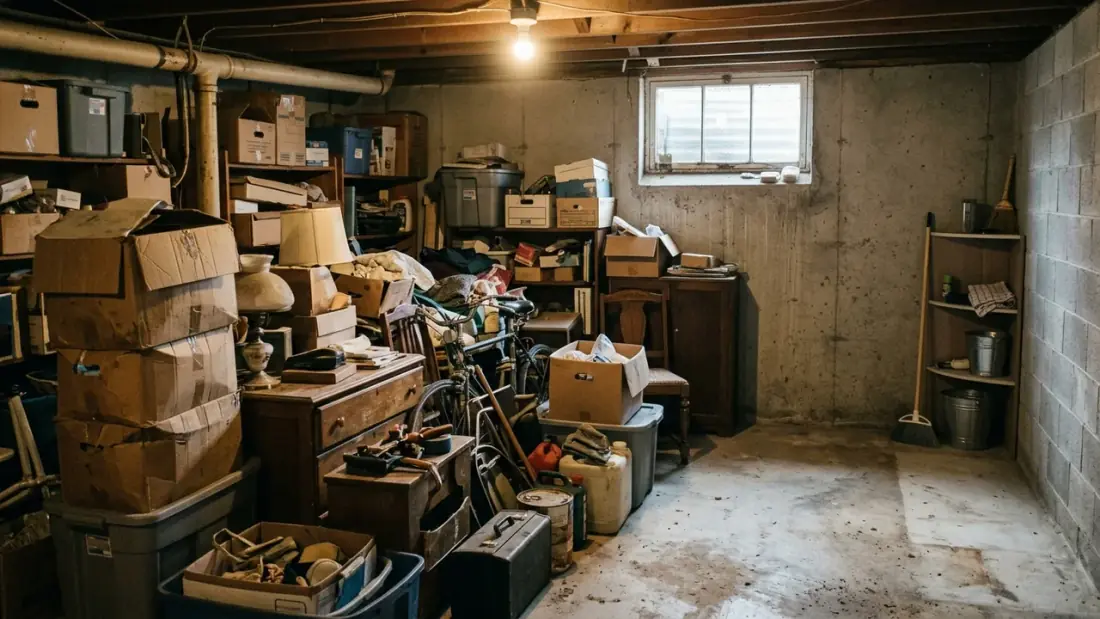
Basement cluttered for 30 years: where to start without giving up
Pragmatic method to tackle a multi-generation basement: sorting grid, emotional phases, rest, pro help. Without judgement.
Read more
Estate cleanout and taxes in Quebec: what the executor needs to know in 2026
The executor's practical guide: which cleanout expenses are deductible, how sales of inherited furniture are taxed, typical errors and how to document everything.
Read more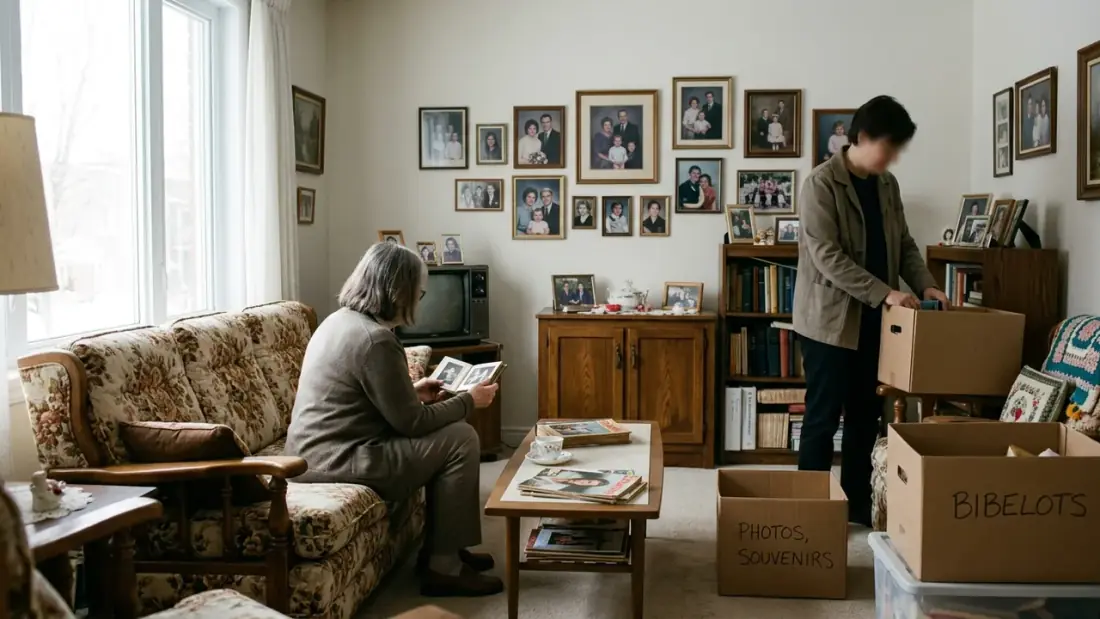
Clearing the home of a deceased relative in Quebec City: step-by-step guide
An honest, practical guide for estate executors: administrative deadlines, sorting method, inheritance rights, specialized services. Without minimizing the grief.
Read more