
End of lease in Quebec: what to do with items left by the former tenant
Practical guide for landlords: legal framework in Quebec, costs to bill the tenant, specialized services, typical scenarios and errors.
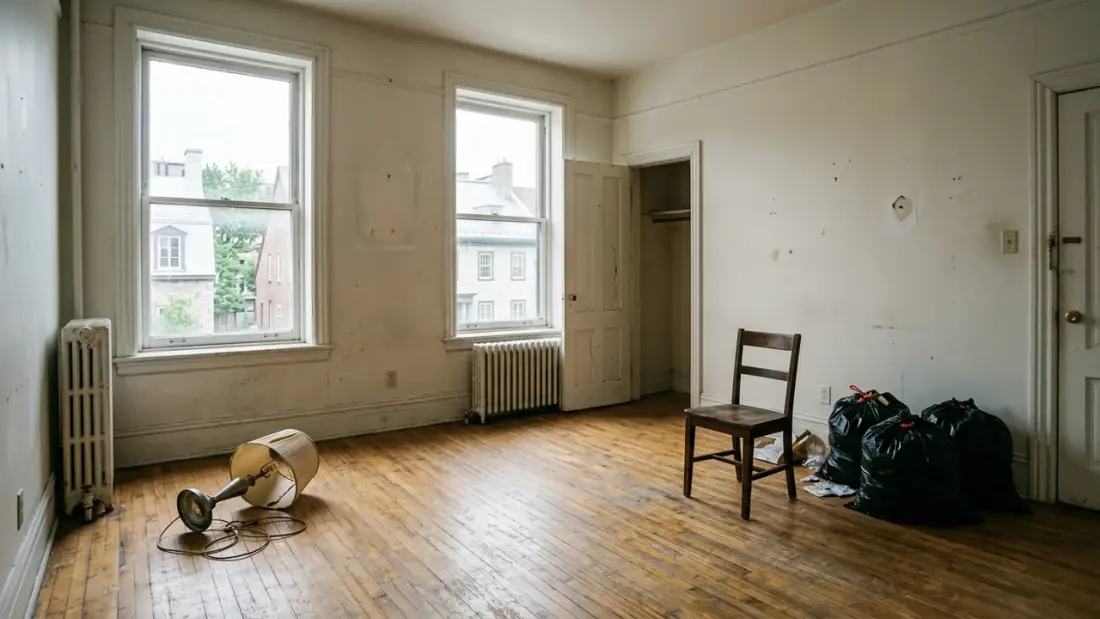
You’re a landlord, the tenant leaves on June 30 (or July 1), and you arrive at the apartment to find: a broken couch, 5 bags of clothes, 2 stained mattresses, a fridge “that still works”, and a stack of “I’ll maybe come back for it”. What to do? What are your rights? And who pays?
This article is for small landlords in Quebec City: owners of duplexes, small 4-plex, condo rented out. Not for large property managers (they have procedures).
The legal framework in Quebec
Rental Tribunal’s position (Tribunal administratif du logement — TAL)
In Quebec, the Civil Code governs landlord-tenant relations. Specifically:
- Article 1890 CcQ: the tenant must vacate the rented place clean and empty at lease end
- Article 1891 CcQ: objects left without indication belong to the landlord after a reasonable delay and after formal notice
- Jurisprudence: “reasonable delay” = typically 15-30 days
In practice:
- June 30 (lease end): tenant vacates, leaves items
- July 1-5: you notice, you photograph everything (dated)
- July 10: you send a formal notice by certified mail (or bailiff) to the tenant at new address — 15 days to retrieve
- July 25: if nothing retrieved, you can dispose or keep the items
- You can bill the tenant for cleanout costs (see below)
The tenant’s address — how to find it
Often, the issue: you don’t know where your old tenant now lives.
Legal sources to find:
- Canada Post forwarding — if the tenant filed a change of address (request with post office)
- The lease itself — often lists an emergency contact (parents, spouse) — contact them
- Social networks — LinkedIn, Facebook may show current city
- Employer — if on lease, employer may know new address (privacy limits apply)
If address really unknown:
- Formal notice published in a local paper (Le Journal de Québec, Le Soleil) satisfies legal requirement in last resort
- Cost: $150-300
- Document it carefully
Don’t want to mess with it:
- Some lawyers offer “tenant search” services for $200-400
- Or hire a bailiff to serve at last known address (presumed delivery if properly addressed)
What you can bill
✅ Legitimately billable:
- Cleanout cost of items left (our service or another service) — documented by invoice
- Proportional cleaning time (if place is very dirty beyond normal wear)
- Specific damages (holes in walls, broken windows, stains that require re-painting)
❌ NOT billable:
- “Normal wear and tear” — carpet a bit worn, walls slightly off-white
- Your personal time to handle the issue (unless you’re a registered property manager)
- Premium rates for “inconvenience”
How to bill the tenant:
- Invoice from specialized service (us, for example) — detailed
- Send a demand letter + copy of invoice, certified mail
- If no payment within 30 days: Small Claims Court (up to $15,000) or TAL
- If the tenant refuses: collection agency (50% commission) or personal suit
Practical reality: collecting is hard. 60% of tenants pay, 40% disappear or contest. Budget the risk.
Standard scenarios
Scenario A: Tenant leaves “reasonable” mess
Situation: some items of modest value, mattress, small furniture, takes about 1/4 truck. Our suggestion:
- You organize formal notice
- After 20 days: we come, 1/4 truck = $299
- Billed to old tenant
Expected billed result: ~$330
Scenario B: Tenant leaves A LOT of stuff
Situation: small apartment full (1/2 truck+), mattress, furniture, boxes of clothes. Our suggestion:
- Formal notice + photos
- Free visit from us to estimate (volume could be more than looks)
- 1/2 truck minimum, maybe full truck
- Billed to tenant: $499-849
Expected billed result: ~$550-850
Scenario C: “I’ll come back next weekend for the rest”
Situation: tenant says they’ll return for items. Day goes by, they don’t come.
Suggestion:
- In writing by text/email: give a specific deadline (“I need these items gone by July 10, otherwise they’ll be disposed at your expense — I’ll charge you $X”)
- After deadline: act
- Keep all the exchange to justify in case of dispute
Scenario D: Tenant left fine, you find items in garage/basement you didn’t know existed
Situation: shared spaces (garage, storage unit) — hard to prove they’re the tenant’s.
Suggestion:
- If rental agreement specifies these spaces: same process as apartment
- Otherwise: treat as abandoned items on your property, 15-day reasonable delay
- Our service can take it no questions
Scenario E: Hazardous materials
Situation: tenant left paint cans, batteries, tires, prescription medications. Critical point: these materials require specific disposal (see our hazardous materials article). Our position: we don’t take hazardous materials. We redirect you to:
- Vanier RDD centre (paint, chemicals)
- Pharmacies (medications)
- Garages (tires, batteries)
The 5 typical errors of first-time landlords
Error 1: Throwing out the stuff the same day
You arrive July 1, you’re furious, you throw everything in the dumpster. Tenant contests 2 weeks later in court saying you threw out “valuable items” (grand-mother’s sewing machine, unique collection, etc.). You have no proof to contradict.
Fix: photograph everything before touching. Keep photos for 6 months minimum.
Error 2: Not sending formal notice
You throw out “normally” without formal notice, assuming obvious abandonment. Tenant files complaint at TAL 3 months later. You lose ($500-1,500 typically).
Fix: always send a formal notice certified mail, even if the tenant seems untraceable.
Error 3: Billing cleanout without clear invoice
You bill the tenant $800 “for cleanout” but you did it yourself, without professional involved. Weak proof.
Fix: use a service like us. Official invoice with company details = clear legal proof.
Error 4: Missing the new rental window
You spend 3 weeks arguing with old tenant, apartment stays empty until August 1. You lose 1 month of rent.
Fix: go fast. If July 1 lease ends, start new advertising July 2. Delegate cleanout to us for turnaround in 48h.
Error 5: Not accepting the loss
Sometimes the old tenant is broke, disappeared, untraceable. You lose. Accept it and move on. Spending 80 hours to recover $500 isn’t profitable.
Fix: budget 1-2% of annual rent as “cleanout contingency fund”.
Our service for landlords
We work regularly with small Quebec City landlords. Our approach:
Reactive intervention (within 48h):
- You call, we come for free on-site visit if volume uncertain
- Firm quote within 10 minutes
- Execution often next morning
- Detailed invoice same day, tax numbers, ready to send to tenant
”End-of-season package” (recurring):
For landlords of multiple units:
- We reserve a block of time in early July for you
- Multi-unit rates (from 3 units: -10%)
- Prioritization over individual clients
Our pricing grid is transparent on our pricing page. For landlords, we offer a “multiple unit” invoice combining several cleanouts for your bookkeeping.
Concrete example — Mr. Levasseur
Mr. Levasseur owns a 5-unit in Limoilou. In 2026:
- 3 tenants leave in July (normal rotation)
- 2 leave items (1 modest, 1 significant)
He calls us the evening of July 1:
- Unit A (modest): 1/8 truck, $175
- Unit B (significant): 1/2 truck + 1 mattress + 1 appliance, $649
Total $824, paid by him up-front. He bills the 2 old tenants:
- Tenant A: doesn’t respond — Mr. Levasseur gives up ($175 loss)
- Tenant B: partially pays $400 of the $649 asked, Mr. Levasseur accepts (lower transaction cost than suing)
Mr. Levasseur’s net: $824 - $400 (B) - $175 (A loss) = $229 cost, spread over annual rental income of 5 units ($72K-90K) = 0.3% annual “operational friction”.
And he re-rented both units for July 15 — 2 weeks of rent loss only, not 2 months.
Final tips
-
Detailed inventory in the lease: list appliances, features with photos at start of lease. Essential to evaluate wear vs damage at end.
-
Solid deposit: Quebec doesn’t allow security deposits like Ontario, but you can ask for first + last month ($1 last month remains in law). Cover end-of-lease issues from first month’s advance.
-
Move-out walk-through: schedule a walk-through with tenant 1 week before departure. Discuss what stays, what goes, document in writing signed by both.
-
Know your network: keep 1-2 reliable cleanout services (like us) in your contacts. When you call and need someone today, you’re glad.
To summarize
- 15-30 days is the “reasonable delay” in Quebec for abandoned items
- Formal notice by certified mail is essential
- Photograph before touching
- Bill with professional invoice
- Accept that 40% of billings won’t collect
For a quote on a specific end-of-lease cleanout: 418 506-0077. Quick and transparent pricing on our pricing page.
Related services and areas
Read next
After separation: empty the 4½ in 48h, action plan
Urgent and emotionally charged situation: a separation means fast cleanout. Pragmatic guide, priority list, respectful service, how to avoid typical regrets.
Read more
Moving in Quebec City on July 1: 7 junk removal mistakes to avoid
On Quebec's moving day (July 1), every minute counts. Here are the 7 mistakes we see every year that cost tenants $200-500 — and how to avoid them.
Read more
Estate cleanout and taxes in Quebec: what the executor needs to know in 2026
The executor's practical guide: which cleanout expenses are deductible, how sales of inherited furniture are taxed, typical errors and how to document everything.
Read more